
🛤️ Luna's Math Quest
Times Table Trail
Multiplication as equal groups and arrays, the times tables, and the matching division facts.
Groups & Arrays
How this station is declared (YAML)
id: tt-concept
title: Groups & Arrays
icon: 🟪
board: mul-concept
bands:
  - 0
  - 2
lesson: multiply
concept: multiply
Lesson: Groups & Arrays — 4 steps
Equal groups
Introduce the idea. Luna opens with the repeatadd visual — repeated addition building toward a product (a + a + … = a × b), across 2 narrated beats, so the concept is seen before it is ever practised.
What Luna says
- Multiplying is a fast way to add equal groups. Here are three groups of four.
- Four plus four plus four is twelve. That's the same as three times four.
In the open config
id: groups
label: Equal groups
beats:
  - say: lmul-1
    caption: Multiplying is a fast way to add equal groups. Here are three groups of four.
    view:
      kind: repeatadd
      key: ra34
      a: 3
      b: 4
  - say: lmul-2
    caption: Four plus four plus four is twelve. That's the same as three times four.
    view:
      kind: repeatadd
      key: ra34
      a: 3
      b: 4
Preview
A rectangle
Worked example. Luna walks one case step by step with the array view — a rectangular array of dots — multiplication as rows × columns, turning the idea into a procedure a child can repeat.
What Luna says
- We can line the same dots up in a neat rectangle — three rows of four.
- Three rows of four is twelve. Rows times columns!
In the open config
id: array
label: A rectangle
beats:
  - say: lmul-3
    caption: We can line the same dots up in a neat rectangle — three rows of four.
    view:
      kind: array
      key: ar34
      a: 3
      b: 4
  - say: lmul-4
    caption: Three rows of four is twelve. Rows times columns!
    view:
      kind: array
      key: ar34
      a: 3
      b: 4
Preview
Another
Worked example. Luna walks one case step by step with the repeatadd view — repeated addition building toward a product (a + a + … = a × b), turning the idea into a procedure a child can repeat.
What Luna says
- Multiplying just counts equal groups really fast. What is two times five?
- Two groups of five is ten.
In the open config
id: fast
label: Another
beats:
  - say: lmul-5
    caption: Multiplying just counts equal groups really fast. What is two times five?
    view:
      kind: repeatadd
      key: ra25
      a: 2
      b: 5
  - say: lmul-6
    caption: Two groups of five is ten.
    view:
      kind: repeatadd
      key: ra25
      a: 2
      b: 5
Preview
Your turn
Your turn. The lesson hands off to the practice board: the child now answers, applying what the array visual — a rectangular array of dots — multiplication as rows × columns just showed.
What Luna says
- Equal groups, or a rectangle — both show what times means. You try!
In the open config
id: go
label: Your turn
beats:
  - say: lmul-7
    caption: Equal groups, or a rectangle — both show what times means. You try!
    view:
      kind: array
      key: ar25
      a: 2
      b: 5
Preview
Tables 2, 5, 10
How this station is declared (YAML)
id: tt-2510
title: Tables 2, 5, 10
icon: ✌️
board: tables
bands:
  - 0
  - 0
lesson: times-2510
concept: multiply
Lesson: Tables 2, 5, 10 — 5 steps
The table
Introduce the idea. Luna opens with the table visual — a times table for n, revealing one fact at a time (skip-counting up the column), across 1 narrated beat, so the concept is seen before it is ever practised.
What Luna says
- A times table is just the list of answers for one number. Don't worry — it looks big, but it's really your friend.
In the open config
id: what
label: The table
beats:
  - say: ltt-1
    caption: A times table is just the list of answers for one number. Don't worry — it looks big, but it's really your friend.
    view:
      kind: table
      key: t5
      "n": 5
      reveal: 3
Preview
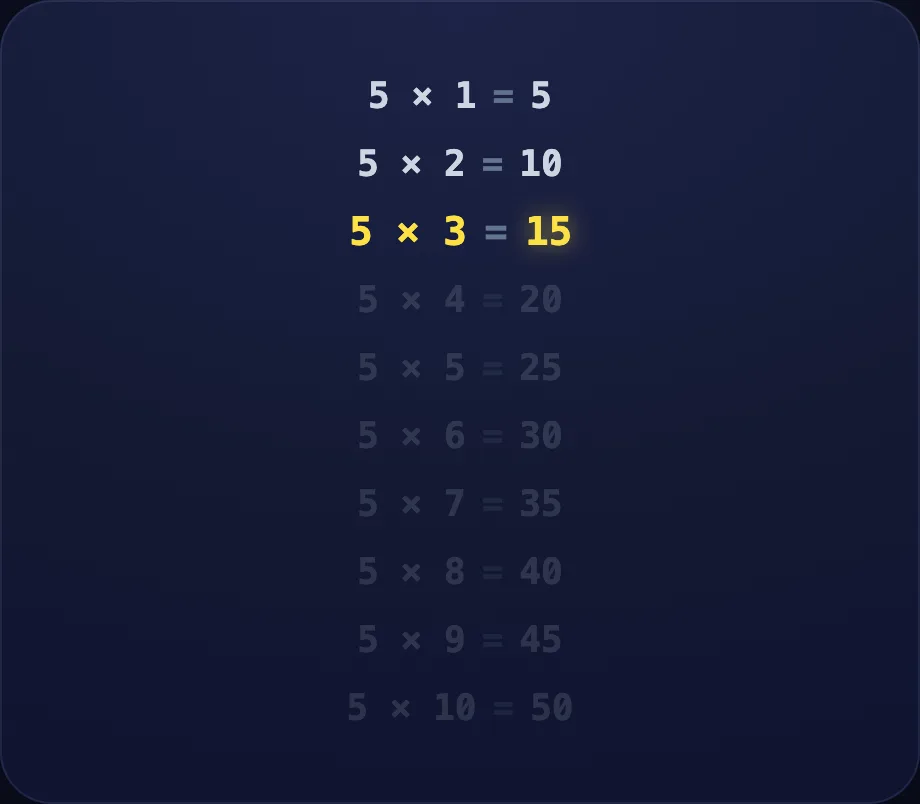
Fives
Worked example. Luna walks one case step by step with the table view — a times table for n, revealing one fact at a time (skip-counting up the column), turning the idea into a procedure a child can repeat.
What Luna says
- Here is the five times table. The answers are just skip counting by five: five, ten, fifteen,
- twenty, twenty-five, and all the way up to fifty.
In the open config
id: fives
label: Fives
beats:
  - say: ltt-2
    caption: "Here is the five times table. The answers are just skip counting by five: five, ten, fifteen,"
    view:
      kind: table
      key: t5
      "n": 5
      reveal: 6
  - say: ltt-3
    caption: twenty, twenty-five, and all the way up to fifty.
    view:
      kind: table
      key: t5
      "n": 5
      reveal: 10
Preview
Twos
Worked example. Luna walks one case step by step with the table view — a times table for n, revealing one fact at a time (skip-counting up the column), turning the idea into a procedure a child can repeat.
What Luna says
- The two times table is simply doubling: two, four, six, eight.
In the open config
id: twos
label: Twos
beats:
  - say: ltt-4
    caption: "The two times table is simply doubling: two, four, six, eight."
    view:
      kind: table
      key: t2
      "n": 2
      reveal: 4
Preview
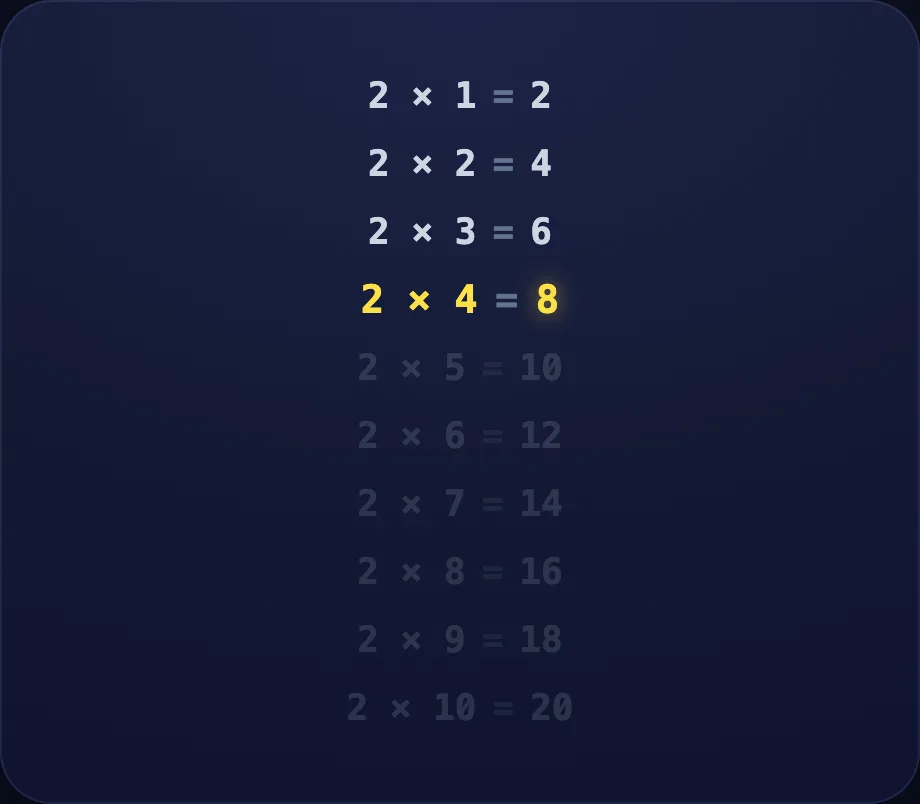
Tens
Worked example. Luna walks one case step by step with the table view — a times table for n, revealing one fact at a time (skip-counting up the column), turning the idea into a procedure a child can repeat. It also draws on big.
What Luna says
- Tens are the easiest of all — just add a zero. Ten, twenty, thirty.
- And the very biggest fact, ten times ten, is one hundred.
In the open config
id: tens
label: Tens
beats:
  - say: ltt-5
    caption: Tens are the easiest of all — just add a zero. Ten, twenty, thirty.
    view:
      kind: table
      key: t10
      "n": 10
      reveal: 3
  - say: ltt-6
    caption: And the very biggest fact, ten times ten, is one hundred.
    view:
      kind: big
      key: tt100
      text: 10 × 10 = 100
      color: "#22d3ee"
Preview
Your turn
Your turn. The lesson hands off to the practice board: the child now answers, applying what the table visual — a times table for n, revealing one fact at a time (skip-counting up the column) just showed.
What Luna says
- You'll learn these by heart, and then big multiplying becomes easy. You try!
In the open config
id: go
label: Your turn
beats:
  - say: ltt-7
    caption: You'll learn these by heart, and then big multiplying becomes easy. You try!
    view:
      kind: table
      key: t5b
      "n": 5
      reveal: 10
Preview
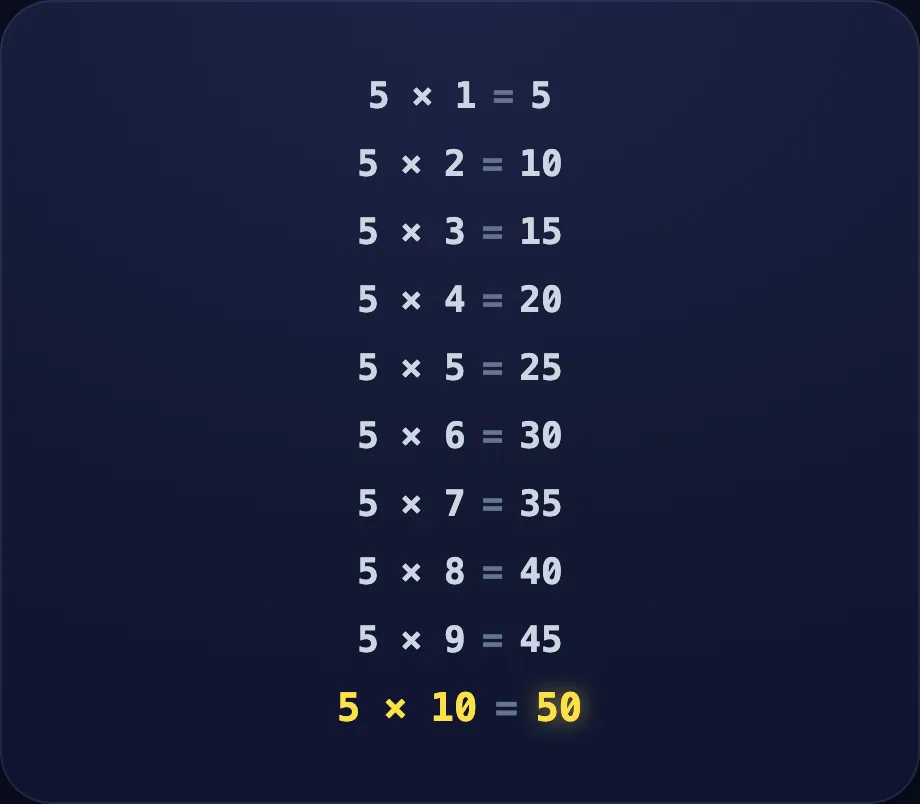
Tables 3, 4, 6
How this station is declared (YAML)
id: tt-346
title: Tables 3, 4, 6
icon: 🎲
board: tables
bands:
  - 1
  - 1
lesson: times-346
concept: multiply
Lesson: Tables 3, 4, 6 — 5 steps
Tricks
Introduce the idea. Luna opens with the table visual — a times table for n, revealing one fact at a time (skip-counting up the column), across 1 narrated beat, so the concept is seen before it is ever practised.
What Luna says
- The threes, fours, and sixes each have a handy trick. Let me show you.
In the open config
id: intro
label: Tricks
beats:
  - say: lt36-1
    caption: The threes, fours, and sixes each have a handy trick. Let me show you.
    view:
      kind: table
      key: t3
      "n": 3
      reveal: 10
Preview
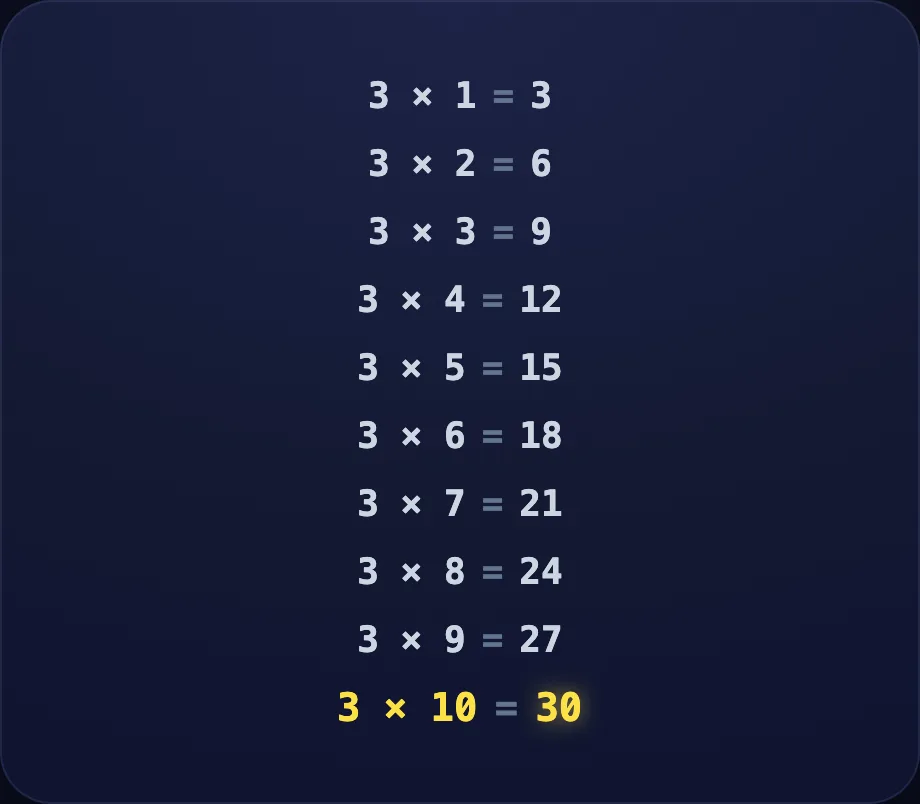
Threes
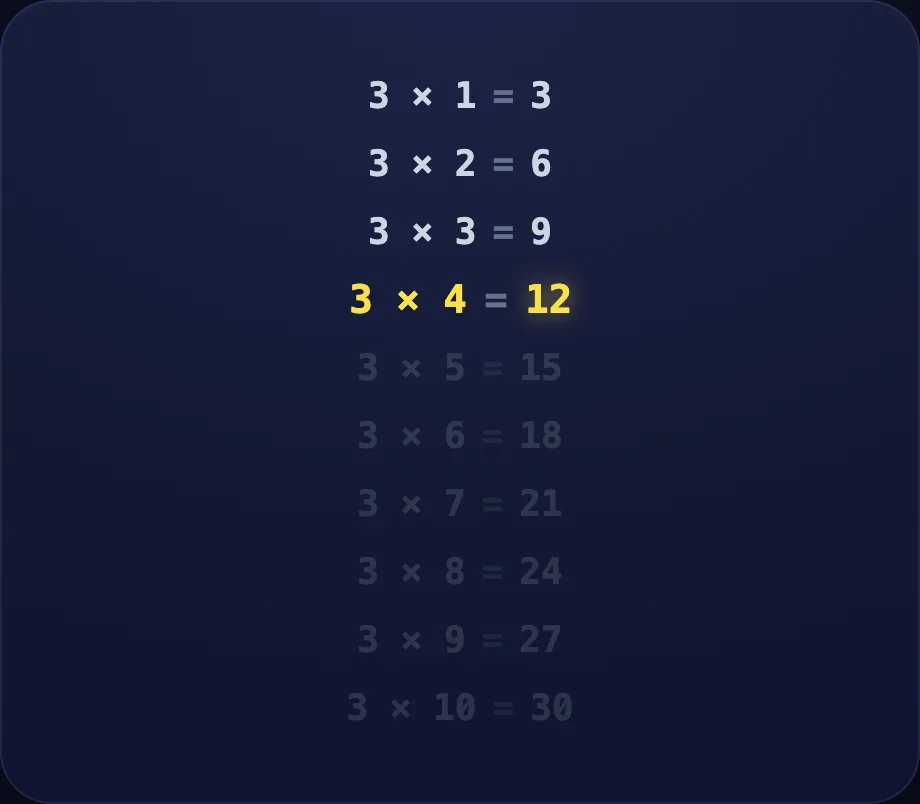
Worked example. Luna walks one case step by step with the table view — a times table for n, revealing one fact at a time (skip-counting up the column), turning the idea into a procedure a child can repeat.
What Luna says
- Threes are skip counting by three: three, six, nine, twelve.
In the open config
id: threes
label: Threes
beats:
  - say: lt36-2
    caption: "Threes are skip counting by three: three, six, nine, twelve."
    view:
      kind: table
      key: t3
      "n": 3
      reveal: 4
Preview
Fours
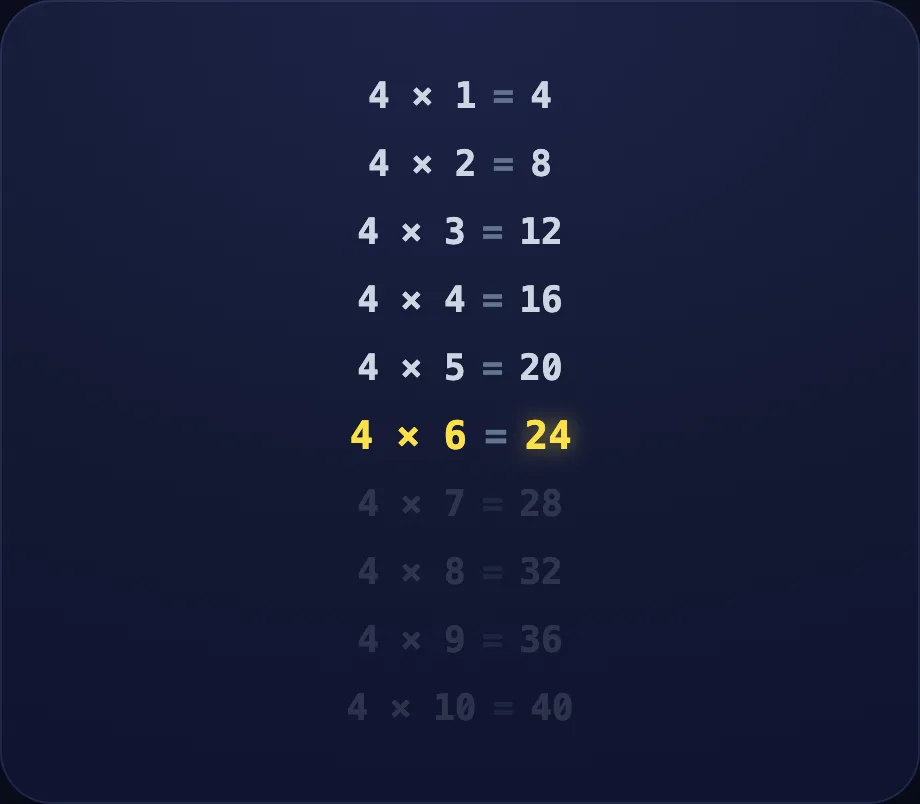
Worked example. Luna walks one case step by step with the table view — a times table for n, revealing one fact at a time (skip-counting up the column), turning the idea into a procedure a child can repeat.
What Luna says
- Fours are double-doubles — double the number, then double again. Six, twelve, twenty-four.
In the open config
id: fours
label: Fours
beats:
  - say: lt36-3
    caption: Fours are double-doubles — double the number, then double again. Six, twelve, twenty-four.
    view:
      kind: table
      key: t4
      "n": 4
      reveal: 6
Preview
Sixes
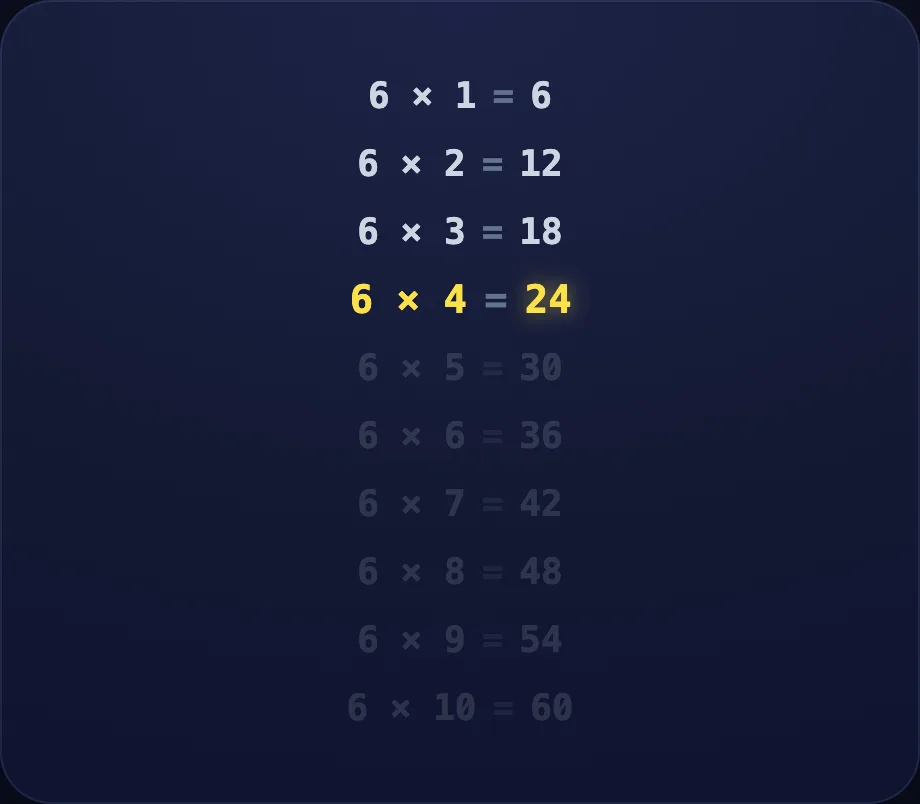
Worked example. Luna walks one case step by step with the table view — a times table for n, revealing one fact at a time (skip-counting up the column), turning the idea into a procedure a child can repeat.
What Luna says
- And sixes are just double the threes! Three fours are twelve, so six fours are twenty-four.
In the open config
id: sixes
label: Sixes
beats:
  - say: lt36-4
    caption: And sixes are just double the threes! Three fours are twelve, so six fours are twenty-four.
    view:
      kind: table
      key: t6
      "n": 6
      reveal: 4
Preview
Your turn
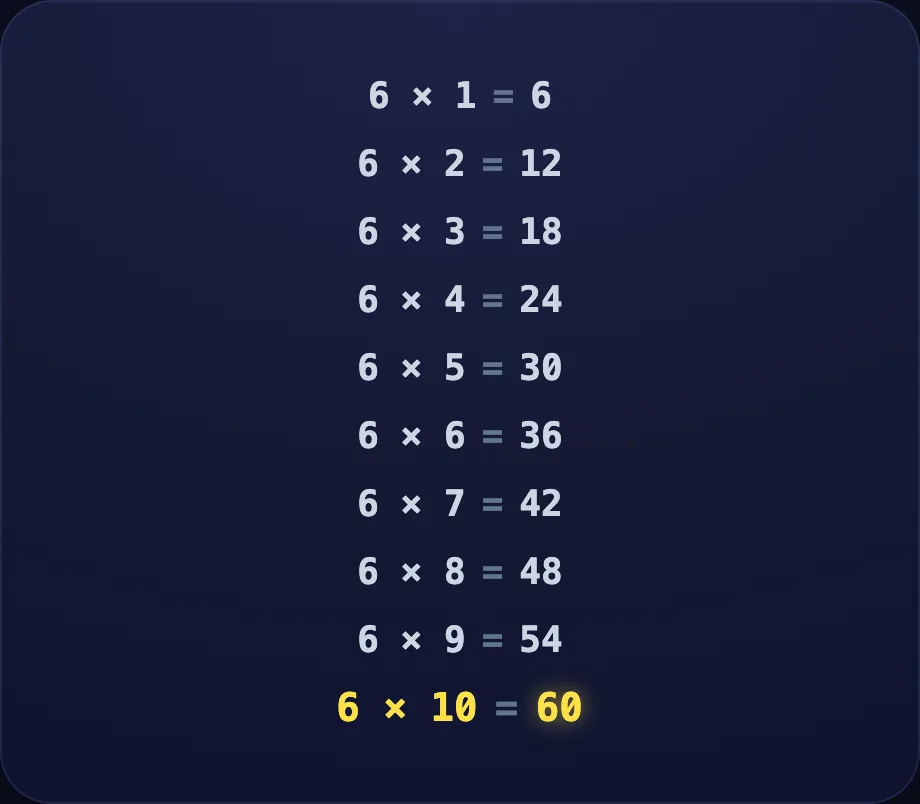
Your turn. The lesson hands off to the practice board: the child now answers, applying what the table visual — a times table for n, revealing one fact at a time (skip-counting up the column) just showed.
What Luna says
- Skip count for threes, double-double for fours, and double the threes for sixes. You try!
In the open config
id: go
label: Your turn
beats:
  - say: lt36-5
    caption: Skip count for threes, double-double for fours, and double the threes for sixes. You try!
    view:
      kind: table
      key: t6b
      "n": 6
      reveal: 10
Preview
Tables 7, 8, 9
How this station is declared (YAML)
id: tt-789
title: Tables 7, 8, 9
icon: 🎪
board: tables
bands:
  - 2
  - 2
lesson: times-789
concept: multiply
Lesson: Tables 7, 8, 9 — 5 steps
Tricky ones
Introduce the idea. Luna opens with the table visual — a times table for n, revealing one fact at a time (skip-counting up the column), across 1 narrated beat, so the concept is seen before it is ever practised.
What Luna says
- Sevens, eights, and nines feel tricky — but they hide some cool tricks.
In the open config
id: intro
label: Tricky ones
beats:
  - say: lt79-1
    caption: Sevens, eights, and nines feel tricky — but they hide some cool tricks.
    view:
      kind: table
      key: t9
      "n": 9
      reveal: 10
Preview
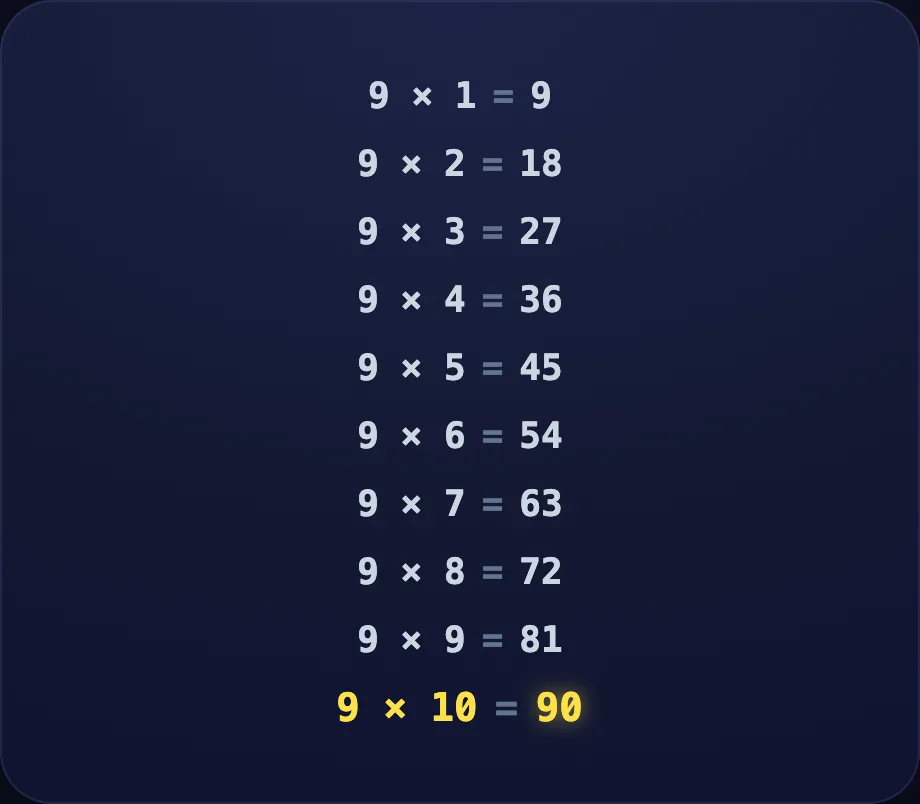
Nine magic
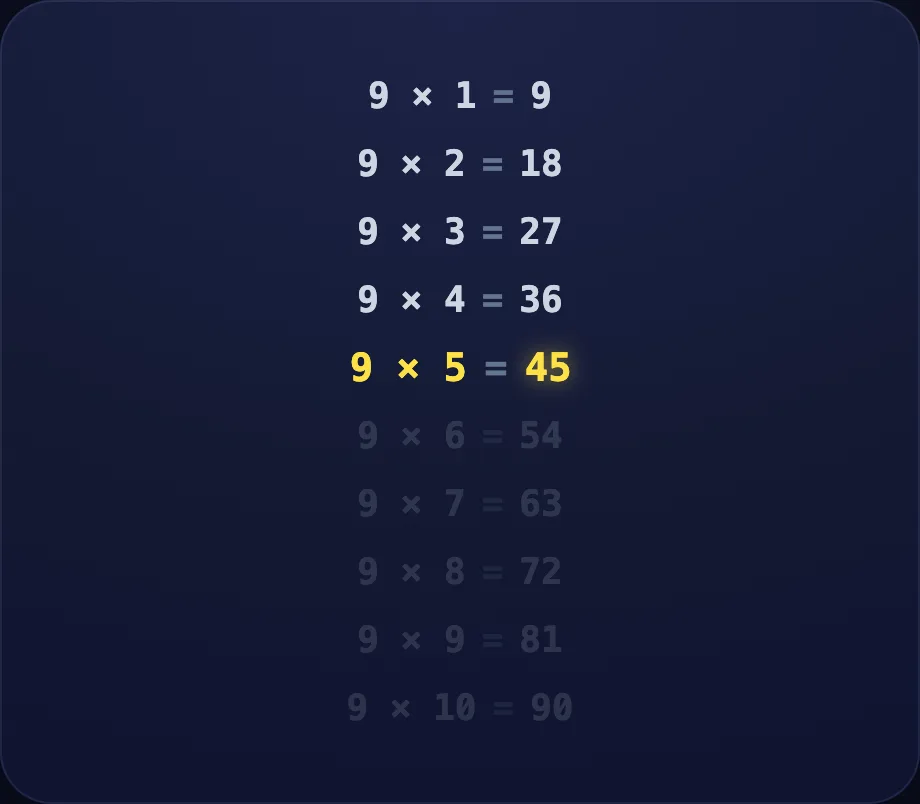
Worked example. Luna walks one case step by step with the table view — a times table for n, revealing one fact at a time (skip-counting up the column), turning the idea into a procedure a child can repeat.
What Luna says
- The nine times table is magic: every answer's two digits add up to nine. Eighteen — one plus eight is nine!
In the open config
id: nine1
label: Nine magic
beats:
  - say: lt79-2
    caption: "The nine times table is magic: every answer's two digits add up to nine. Eighteen — one plus eight is nine!"
    view:
      kind: table
      key: t9
      "n": 9
      reveal: 5
Preview
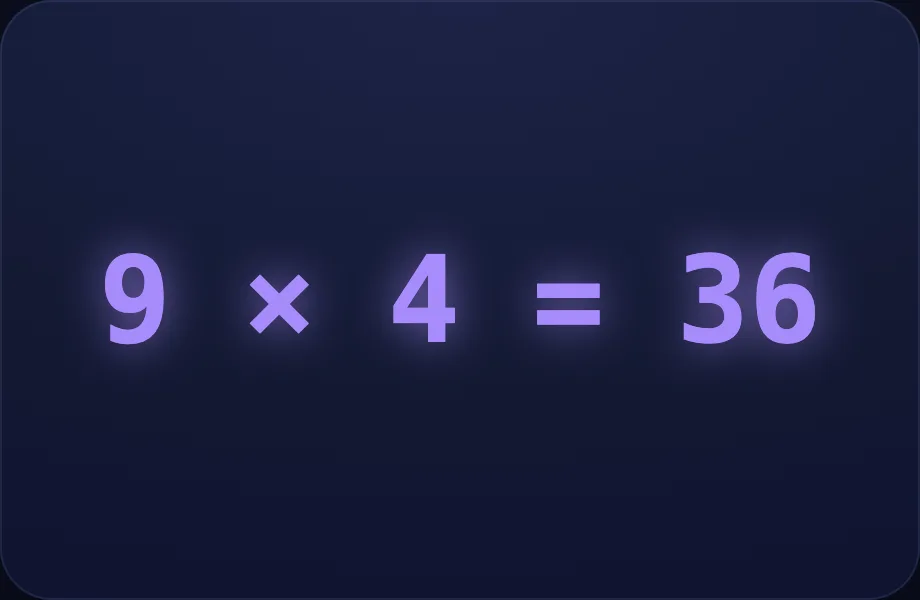
Nine trick
Worked example. Luna walks one case step by step with the big view — a single big numeral or label, for emphasis / answer-reveal beats, turning the idea into a procedure a child can repeat.
What Luna says
- Here's the other nine trick: the tens digit is always one less than the number you times by. Nine fours — the four drops to three, so thirty-six.
In the open config
id: nine2
label: Nine trick
beats:
  - say: lt79-3
    caption: "Here's the other nine trick: the tens digit is always one less than the number you times by. Nine fours — the four drops to three, so thirty-six."
    view:
      kind: big
      key: n94
      text: 9 × 4 = 36
      color: "#a78bfa"
Preview
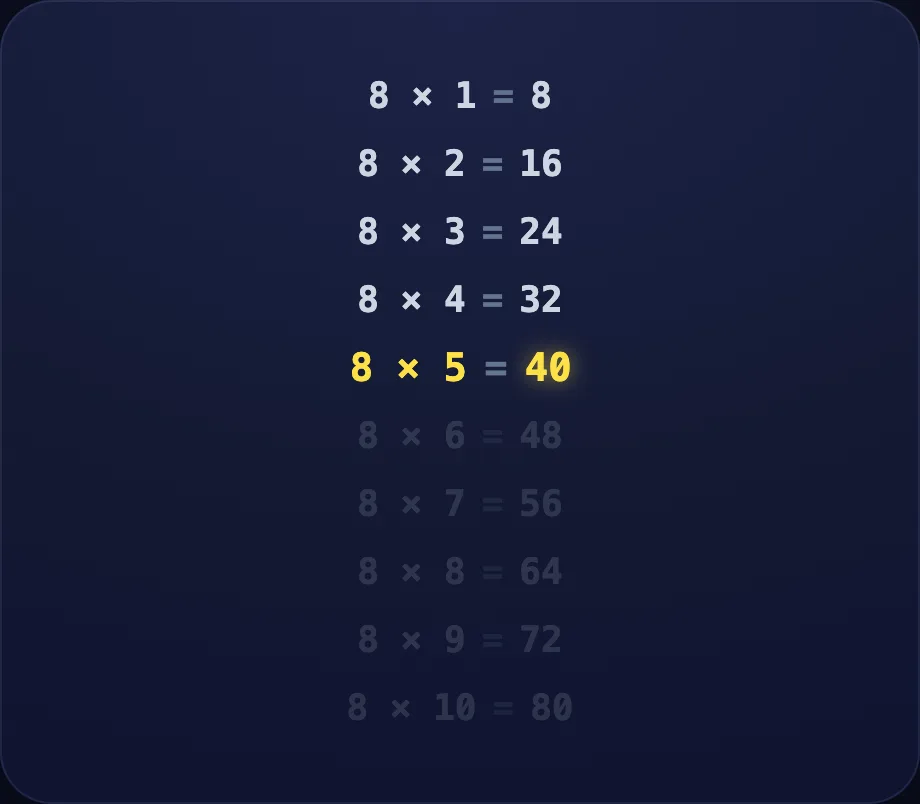
Eights & sevens
Worked example. Luna walks one case step by step with the table view — a times table for n, revealing one fact at a time (skip-counting up the column), turning the idea into a procedure a child can repeat.
What Luna says
- Eights are double the fours. And you already know lots of sevens — seven times two is just the twos table!
In the open config
id: eightseven
label: Eights & sevens
beats:
  - say: lt79-4
    caption: Eights are double the fours. And you already know lots of sevens — seven times two is just the twos table!
    view:
      kind: table
      key: t8
      "n": 8
      reveal: 5
Preview
Your turn
Your turn. The lesson hands off to the practice board: the child now answers, applying what the table visual — a times table for n, revealing one fact at a time (skip-counting up the column) just showed.
What Luna says
- Use the nine tricks, double the fours for eights, and remember you already know half your sevens. You try!
In the open config
id: go
label: Your turn
beats:
  - say: lt79-5
    caption: Use the nine tricks, double the fours for eights, and remember you already know half your sevens. You try!
    view:
      kind: table
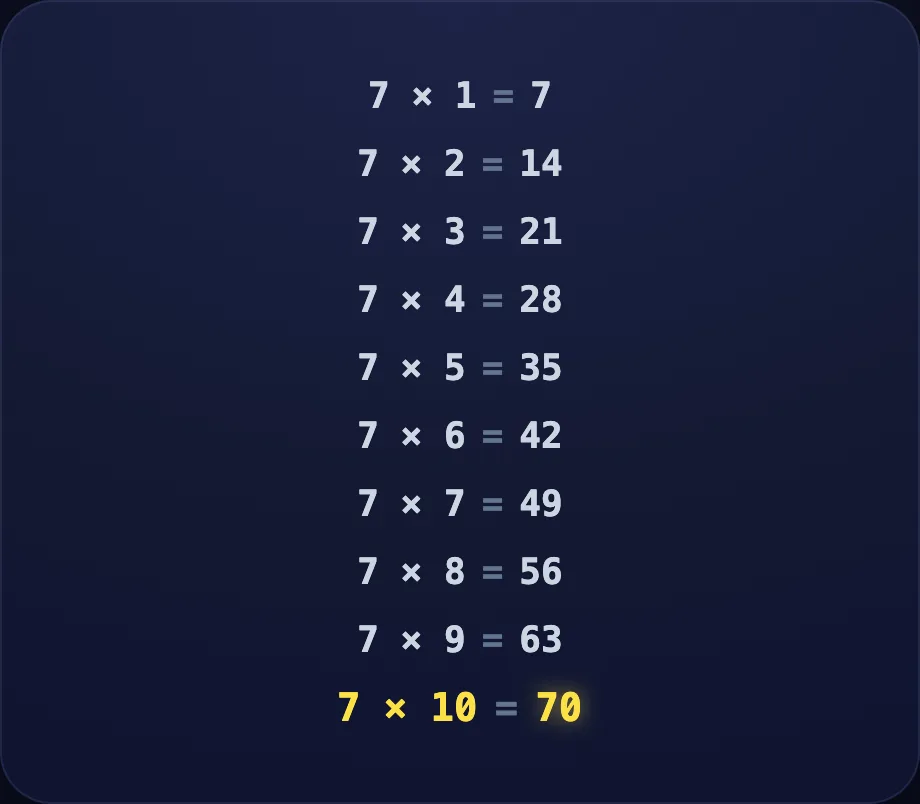
      key: t7
      "n": 7
      reveal: 10
Preview
Division Facts
How this station is declared (YAML)
id: tt-divfacts
title: Division Facts
icon: ➗
board: div-facts
bands:
  - 0
  - 2
lesson: division
concept: division
Lesson: Division Facts — 4 steps
Share fairly
Introduce the idea. Luna opens with the groups visual — a total shared into equal groups — division as sharing, across 2 narrated beats, so the concept is seen before it is ever practised.
What Luna says
- Dividing means splitting into equal groups. Twelve cookies shared among three friends.
- Each friend gets four. Twelve divided by three is four.
In the open config
id: share
label: Share fairly
beats:
  - say: ldiv-1
    caption: Dividing means splitting into equal groups. Twelve cookies shared among three friends.
    view:
      kind: groups
      key: g123
      total: 12
      groups: 3
  - say: ldiv-2
    caption: Each friend gets four. Twelve divided by three is four.
    view:
      kind: groups
      key: g123
      total: 12
      groups: 3
Preview
Opposite of ×
Worked example. Luna walks one case step by step with the multable view — a multiplication grid that sweeps to the answer cell (row × col), turning the idea into a procedure a child can repeat.
What Luna says
- Division is the opposite of multiplying. Three times four is twelve, so twelve divided by three is four.
In the open config
id: opposite
label: Opposite of ×
beats:
  - say: ldiv-3
    caption: Division is the opposite of multiplying. Three times four is twelve, so twelve divided by three is four.
    view:
      kind: multable
      key: mt34
      hint:
        kind: multable
        row: 3
        col: 4
        mode: div
Preview
Use the table
Worked example. Luna walks one case step by step with the groups view — a total shared into equal groups — division as sharing, turning the idea into a procedure a child can repeat.
What Luna says
- That means your times tables help you divide! What is fifteen divided by five?
- Five groups of three — so fifteen divided by five is three.
In the open config
id: use
label: Use the table
beats:
  - say: ldiv-4
    caption: That means your times tables help you divide! What is fifteen divided by five?
    view:
      kind: groups
      key: g153
      total: 15
      groups: 5
  - say: ldiv-5
    caption: Five groups of three — so fifteen divided by five is three.
    view:
      kind: groups
      key: g153
      total: 15
      groups: 5
Preview
Your turn
Your turn. The lesson hands off to the practice board: the child now answers, applying what the multable visual — a multiplication grid that sweeps to the answer cell (row × col) just showed.
What Luna says
- To divide, just ask: what number times the divisor gives this? You try!
In the open config
id: go
label: Your turn
beats:
  - say: ldiv-6
    caption: "To divide, just ask: what number times the divisor gives this? You try!"
    view:
      kind: multable
      key: mt53
      hint:
        kind: multable
        row: 5
        col: 3
        mode: div
Preview